Think about the last time you made a meaningful change to your lifestyle using a fitness app; whether it was tracking your steps, logging your meals, or following an on-demand workout routine at 6 in the morning.
Health and fitness app development has quietly become one of the most lucrative, impactful, and strategically sound investments in the tech landscape. Whether you are a startup founder looking for your next big idea, an investor searching for a high-growth vertical, or a healthcare company wanting to expand digitally; investing in a health and fitness app is always profitable with extended perks.
In this blog, we will break down five compelling, data-backed reasons why investing in fitness app development services is an excellent decision.
5 Reason to Invest in Health and Fitness App Development
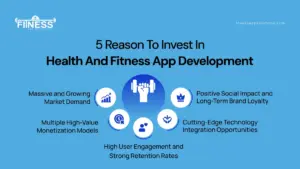
1.Massive and Growing Market Demand
Before investing into a fitness app, it is necessary to look into the stats, market growth, and demand to ensure high ROI, income and other profits.
Global Stats/Market Projection
The global fitness app market was valued at approximately $10.58 billion in 2024, and it is projected to reach $30.28 billion by 2032, growing at a compound annual growth rate (CAGR) of 14.13%. Some analysts paint an even bolder picture, Technavio projects the market will increase by over $101 billion between 2024 and 2029, at an aggressive CAGR of 24.2%.
Post-Pandemic Shift Toward Personal Health
The COVID-19 pandemic permanently altered our relationship with fitness. When gyms shut down overnight, millions of people turned to their smartphones. What started as a temporary workaround became a lasting habit. Users discovered the convenience of working out on their own terms, no commute, no waiting for equipment, no fixed schedule. That behavioural shift did not reverse even when gyms reopened; it evolved into a hybrid model that apps are perfectly designed to serve.
Massive Smartphone Usage
The Digital 2026 Global Overview Report highlights that smartphones have become the dominant gateway to the internet worldwide. Nearly 96% of online adults use a mobile phone for internet access, with 93.7% specifically using smartphones, showing that mobile devices are almost universal among internet users.
Smartphones are not just widespread; they are central to digital behaviour. Only a tiny share of users (about 1.2%) relies solely on basic feature phones, while most combine smartphones with other devices, reinforcing the smartphone’s role as the primary access point.
At the same time, reliance on traditional devices is declining. Less than 60% of users now access the internet via computers, and this share continues to fall, especially among younger users. This shift clearly indicates a mobile-first (and increasingly mobile-only) internet ecosystem.
Source: Data Reportal
Main Audience: Millennials and Gen Z
Millennials account for roughly 60% of fitness app users, with Gen Z making up another 25%. These demographics do not just download apps; they pay for them, they review them, they share them, and they stick with them when the experience is right. Building a product for this audience is building for the most active consumer base on the planet.
2.Multiple High-Value Monetization Models
One of the most powerful things about health and fitness app development is that there is no single way to make money from it. Fitness apps are among the most monetization-flexible products in the app economy. You can explore various revenue stream or financial models.
Freemium, Subscriptions, and In-App Purchases
The freemium model, offering a solid free tier while reserving premium features for paying subscribers, has become the gold standard in fitness apps. Platforms like MyFitnessPal, Strava, and Nike Training Club have perfected this approach. What is striking is how willing users are to pay once they experience value: research shows that subscription-based fitness apps demonstrate 30% higher engagement rates compared to fully free versions.
Annual subscriptions are particularly powerful from a retention standpoint. Apps offering annual subscription plans see a 33% retention rate over 12 months, significantly higher than monthly plans, which creates a predictable, recurring revenue foundation that investors love.
B2B Partnerships with Gyms, Insurers, and Employers
Consumer monetization is just one piece of the puzzle. The B2B opportunity in fitness app development services is enormous and frequently underestimated. Employers increasingly recognize that a healthy workforce is a more productive one. A meta-analysis found that well-implemented workplace wellness programs yield an average ROI of $3.27 for every dollar spent on health costs. More recent 2026 industry data put this figure even higher, at a 6:1 ROI on average.
Health insurers, gym chains, corporate HR departments, and hospital networks are all actively seeking white-label or enterprise fitness app solutions. New fitness businesses launching branded apps see an average 3x ROI within the first two years, and health clubs using branded fitness apps report an 35% increase in customer engagement.
Wearable Integration and Premium Upsells
The wearable devices market is the most exciting frontier for fitness app monetization. Apps that integrate deeply with Apple Watch, Fitbit, Garmin, and similar devices unlock premium data layers, real-time heart rate, sleep quality, blood oxygen, calorie tracking, that users are willing to pay significantly more for. The wearable devices segment within fitness apps is projected to grow at a CAGR of 17.5% through upcoming years, the fastest of any sub-segment.
3.High User Engagement and Strong Retention Rates
There is a well-known problem in the app economy: most apps are downloaded, opened once, and quietly forgotten; increasing the app abandonment rate. Fitness apps are different and understanding why is crucial for anyone evaluating health and fitness app development as an investment.
Habit-Forming by Design
Fitness is fundamentally about daily habits. When your product is indulged into a user’s morning routine, a workout check-in, a step count, a calorie log, it becomes genuinely hard to remove from their life. Users who stay active daily during their first week of using a fitness app are 80% more likely to still be using it six months later. That kind of early engagement signal is gold from a product-market-fit perspective.
Gamification, Streaks, and Social Accountability
The best fitness apps do not just track; they motivate users to keep using the app with their excellent retention features. Leaderboards, achievement badges, streak counters, and community challenges tap into deep psychological drivers: competition, recognition, and belonging. The impact is measurable.
For example, when Strava introduced its “Challenges” feature in 2022, its 90-day retention rate jumped from 18% to 32%, daily active users increased by 28%, and premium subscriptions grew by 15%.
AI-Driven Personalization as the Retention Multiplier
Perhaps the most significant benefits of fitness apps in recent years have been the integration of artificial intelligence. Health and fitness applications that incorporate AI-driven personalization show 50% higher retention rates than those relying on generic content. When a user feels that the app truly understands their body, their schedule, and their goals, they stop looking for alternatives.
4.Cutting-Edge Technology Integration Opportunities
If you are someone who gets excited about where technology is going, health and fitness app development is one of the most intellectually thrilling spaces to build in right now. The convergence of AI, wearables, AR/VR, and IoT in a single fitness app is rare, and it creates powerful differentiation opportunities for builders who move early.
AI and Machine Learning for Hyper-Personalized Plans
The era of generic, one-size-fits-all workout plans is over. Users today expect apps to know them, their fitness level, their recovery data, their preferences, their schedule. AI makes this possible at scale.
For example, Platforms like Peloton have already rolled out AI-generated weekly workout plans based on previous activity history. Apps like Gym streak use generative AI to create real-time adaptive routines based on how a user performed, not just what they planned to do.
It resulted as AI-driven fitness coaching apps are expected to dominate the market by 2027, and the category is growing fast enough that first-movers in niche verticals, prenatal fitness, adaptive training for people with disabilities, senior wellness, still have significant runway to build defensible positions.
IoT and Wearable Device Synchronization
In the United States, approximately 1 in 5 Americans owns a fitness tracker or smartwatch. That number is growing, and as it grows, so does the expectation that fitness apps will speak seamlessly to these devices. Apple HealthKit, Google Health Connect, Fitbit’s API, and Garmin Connect have become standard integration points for any serious fitness app investment. Apps that leverage wearable data offer a qualitatively richer experience, and command meaningfully higher monetization potential as a result.
AR and VR for Immersive Workout Experiences
Virtual reality fitness is no longer a novelty, it is an emerging category with real commercial momentum. VR fitness apps are growing at a CAGR of 22%, driven by platforms that make exercise feel more like entertainment than obligation. Augmented reality is similarly opening new doors: imagine a running app that overlays real-time pace data and course maps onto your actual field of view, or a strength training app that uses your phone camera to provide form corrections in real time.
These technologies are still early, which is precisely why investing in fitness app development services that are designed to incorporate them is so strategically valuable. Getting the infrastructure right now means being positioned to lead when mainstream adoption arrives.
5.Positive Social Impact and Long-Term Brand Loyalty
Beyond the financial returns, there is a compelling human story behind health and fitness app development, and in 2026, that story matters more to consumers than ever before
Addressing a Genuine Public Issues
The WHO’s physical activity guidelines recommend 150 minutes of moderate aerobic exercise per week for adults. Most people fall dramatically short of that target. Fitness apps are among the most scalable, accessible tools available to close that gap, and governments and employers alike are beginning to subsidize access to them as a result.
Mental Health and Holistic Wellness Positioning
One of the most significant expansions in the benefits of fitness apps has been the move into mental health. Depression and anxiety disorders cost the global economy approximately $1 trillion annually in lost productivity, according to the WHO. In response, employers, insurers, and governments are actively seeking digital mental wellness solutions.
Summarizing It
Health and fitness app development is no longer just a trend; it is a strategic investment opportunity with long-term growth potential. From a rapidly expanding global market and the dominance of smartphone usage to flexible monetization models and strong user engagement, the ecosystem offers both scalability and sustainability.
What makes this space even more compelling is its ability to combine profitability with purpose. Businesses are not only generating consistent revenue through subscriptions, partnerships, and wearable integrations, but also contributing to improved physical and mental well-being worldwide.
As emerging technologies like AI, AR/VR, and IoT continue to reshape user experiences, investing in fitness app development services today positions businesses to lead tomorrow’s digital health revolution. Whether targeting Millennials and Gen Z or partnering with enterprises, the opportunities are vast and still growing.
Frequently Asked Questions (FAQs)
What is health and fitness app development?
Health and fitness app development refers to creating mobile or web applications that help users track workouts, monitor health metrics, follow diet plans, and improve overall wellness.
Why should businesses invest in fitness app development services?
Businesses can benefit from high market demand, recurring revenue models, strong user engagement, and opportunities to integrate advanced technologies like AI and wearables.
How do fitness apps make money?
Fitness apps generate revenue through subscriptions, freemium models, in-app purchases, ads, and B2B partnerships with gyms, insurers, and corporate wellness programs.
What are the key benefits of fitness apps for users?
Users gain access to personalized workouts, health tracking, convenience, motivation through gamification, and improved physical and mental well-being.
Are fitness apps profitable in the long run?
Yes, fitness apps can be highly profitable due to high retention rates, recurring subscriptions, and increasing global demand, especially with the rise of smartphone usage and digital health awareness.