Physical health is not more important than mental health. The present-day technology is assisting in bridging the gap between the two. The contemporary fitness applications no longer require you to just count calories or steps. They are currently used as mental health monitoring apps and provide the means that can be used to alleviate stress, monitor emotions, and ensure good health.
There are many effective apps for tracking mental health that can assist users to discern the way exercise, sleep, diet, and daily routines can affect their mood. These apps allow mental health care to be more approachable and accessible for daily use by integrating science-based wellness applications together with convenient digital functionality.
The Science of Exercise and Mental Health
It has been observed that frequent exercise lowers stress, anxiety, and depression symptoms. Workouts cause the body to release endorphins, brain chemicals that make one feel good. It also reduces stress hormones and improves the quality of sleep.
Many emphasize that regular exercise reduces symptoms of anxiety and depression while improving mood and cognitive function. Moving objects like walking, stretching, or some light strength training, even of the moderate level, can have a positive impact on emotional equilibrium.
According to World Health Organization; WHO (2022), integrating mental health into primary and digital healthcare systems is essential for achieving universal health coverage. Fitness apps use this science by motivating people to be consistent and work to associate physical movement with emotional results.
What are Fitness App Features That Boost Mental Well-Being & Stress Management?
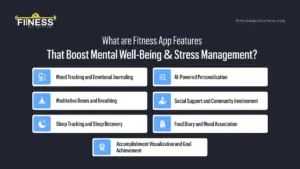
1.Mood Tracking and Emotional Journaling
Mood tracking is one of the most useful features of the modern apps used to monitor the mental state.
Users can:
- Log daily emotions
- Record stress levels
- Add short journal entries
- Monitor the mood changes with time.
With the help of trends, one can find out which factors can influence his or her mood: sleep deprivation, unhealthy nutrition, or skipped exercises. An effective mental health tracker application transforms disjointed emotions into quantifiable information, which is simpler to identify trends and make changes.
2.Meditative Doses and Breathing
Stress relief apps have become a frequent feature of fitness apps. Many apps include:
- Guided meditation sessions
- Deep breathing exercises
- Relaxation techniques
- Mindfulness reminders
Such tools are used to relax the nervous system and enhance concentration. Tension can be minimized even by short breathing sessions that help to achieve clarity. Combining these aspects, mental health tracking apps provide one with a lifeline when they are under stress.
3.Sleep Tracking and Sleep Recovery
The two are closely related to sleep and mental health. Sleep deprivation may result in moodiness, lack of concentration, and anxiety.
- Modern fitness apps track:
- Total sleep duration
- Sleep stages (light, deep, REM)
- Sleep consistency
- Recovery scores
Through the differentiation of sleep with mood data, a mental health tracking app can guide users to know how rest affects emotional stability. The more individuals observe notable relationships between the quality of sleep and the level of stress, the higher the chances that they will think of healthy sleeping habits.
4.AI-Powered Personalization
The wellness tools are becoming smarter with artificial intelligence. Rather than providing generic guidance, most mental health tracking apps have become individualized based on suggestions depending on the user’s behaviour.
For example:
- Recommendation to do a light exercise on stressful days.
- Suggesting meditation in case of bad sleep.
- Revision of objectives in case of burnouts.
This one-on-one strategy will enhance participation and make mental health care support seem achievable and feasible.
5.Social Support and Community Involvement
The community characteristics provide an additional emotional support. Isolation may be minimized by sharing progress, joining challenges, or taking part in group-related activities.
Interpersonal communication in fitness websites:
- Builds accountability
- Encourages motivation
- Gives emotional support.
- Creates shared goals
The advantages of using apps to monitor mental health can be enhanced with the help of a supportive community, which is particularly relevant to those who want to find the connection between people as well as self-development.
6.Food Diary and Mood Association
Our diet has an influence on our mood. Mixed meals help to maintain constant energy levels and improve concentration, whereas too many processed foods can cause mood swings.
Nutrition tracking is included in many mental health tracking apps that allow the user to:
- Monitor daily food intake
- Track hydration
- Compare mood and meal patterns.
In the long term, this aspect can help one to be aware of the effect of diet on emotional well-being, promoting smarter lifestyle decisions.
7.Accomplishment Visualization and Goal Achievement
Motivation improves with the sight of progress. Computerized applications will present visual dashboards that indicate the improvement of:
- Mood stability
- Workout consistency
- Sleep quality
- Stress levels
Milestone tracking and clear graphs will assist the user in staying committed. An organized mental health tracking app will turn intangible objectives, such as lessening stress, into quantifiable accomplishments.
Final Thoughts
Fitness apps nowadays have become full-fledged wellness apps. They are integrated to enable emotional balance by tracking exercises, monitoring mood, tracking sleep, using meditation features, and artificial intelligence insights.
Through regular apps for tracking mental health from where a person will be able to gain a greater understanding of themselves, live with less stress, and create healthier everyday routines. With a carefully crafted mental health tracking application, one does not need professional attention, but it can be an effective tool in the prevention, self-monitoring, and daily stress alleviation.Technology is not only assisting people to move faster, but it is also assisting them to feel better and think more clearly, and also live a healthier life.
Frequently Asked Questions (FAQs)
1.What are mental health tracking applications?
Mental health apps are the digital applications that enable users to check mood, stress, sleep, exercise, and other wellness aspects to further comprehend the emotional patterns.
2.What is the role of a mental health tracking application in reducing stress?
One of them, a mental health tracking app, can be beneficial in providing the user with mood logs, meditation sessions, breathing strategies, and data analyses to recognize stress motivators and learn to control them.
3.Do sports apps help to alleviate anxiety symptoms?
Although they are not a medical intervention, frequent exercise tracking, mindfulness features, and sleep tracking on fitness apps can be a supplement to less anxiety and better emotional regulation.
4.What is the recommended frequency of using apps to monitor mental health?
To achieve the most successful outcomes, it is necessary to check-in regularly (daily or at least 3-5 times per week) and develop a consistent data which will allow you to see meaningful tendencies.
5.Will therapy be replaced by these apps?
No. Mental health tracking apps are helpful. They are not used instead of professional therapy, counselling, or medical treatment as needed.
6.Does a mental health tracking app keep my personal data safe?
The majority of the reliable apps adhere to the privacy norms and encryption. Nevertheless, users should not fail to read privacy policies before they give away sensitive information.
7.What are the features that I need in a mental health tracking app?
Find mood tracking, guided meditation, sleep tracking, personalized recommendations, nutrition tracking, and progress visualization features.
8.Are the free apps used to monitor mental health adequate?
Numerous free apps are simple mood trackers and meditation programs. Nevertheless, the high prices tend to incorporate more insights, AI customization, and more analytics.