The global fitness app market is booming like never before. In 2024 alone, leading fitness and workout apps recorded almost 14 million downloads worldwide, signalling sustained user demand for digital fitness solutions. Moreover, the fitness app market is projected to grow to $10.06 billion by 2029, with an increasing number of users embracing digital tools for health and wellness.
Fitness apps today offer far more than simple step tracking. They provide personalized training plans, nutrition guidance, wearable device integration, gamification challenges, and much more. But building a successful fitness app requires more than a great idea; it demands the right technology stack. The tech stack you choose will determine how scalable your app is, how fast it can perform, how well it integrates with third-party services, and how engaging the user experience will be.
What are the Key Considerations for Choosing a Tech Stack for Fitness App Development?
Before diving into specific tools and frameworks, you need a clear picture of your app’s requirements and constraints. Consider the following factors:
1. Audience and Scale
Fitness apps serve diverse audiences, from casual users who want basic workout tracking to professional athletes and trainers who need real-time performance analytics. Understanding your audience informs choices about performance, security, and platform support.
Expected traffic and scale also play a role. Apps aimed at millions of users require highly scalable backends and robust cloud infrastructure, whereas niche apps with a smaller user base may prioritize rapid development and flexibility.
2. Core Requirements
Fitness apps typically need:
- Real-time data processing (e.g., live workout metrics)
- Offline capabilities (users should be able to use features without constant connectivity)
- Security and compliance (especially for health-related data)
- Cross-platform support (iOS, Android, and sometimes web)Your tech stack must accommodate these requirements from day one rather than as an afterthought.
3. Trade-offs
Every tech choice comes with trade-offs:
- Ease of development vs. performance:
Cross-platform frameworks boost development speed, but sometimes at a slight performance cost compared to native solutions. - Open-source vs. proprietary tools:
Open-source frameworks offer flexibility and cost savings, whereas proprietary tools may offer stronger support and enterprise-grade features. - Complexity vs. maintainability:
More advanced stacks may future-proof your app, but increase development and maintenance effort.
What are the Benefits of Choosing the Right Tech Stack for Fitness App Development?
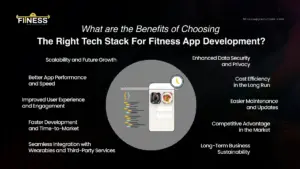
Choosing the right tech stack for fitness app development has a direct impact on the app’s success, scalability, and user satisfaction.
1. Scalability and Future Growth
A well-chosen tech stack allows your fitness app to grow smoothly as user numbers increase.
Why it matters:
- Fitness apps often start small (MVP) and scale rapidly after launch.
- User activity spikes during peak hours (morning workouts, New Year resolutions, fitness challenges).
Benefits:
- Handles thousands or millions of users without performance drops.
- Supports adding new features (AI coaching, live workouts, wearable integrations).
- Prevents costly re-architecture in the future.
2. Better App Performance and Speed
Performance is critical for fitness apps that rely on real-time tracking and sensor data.
Why it matters:
- Lag or crashes during workouts frustrate users.
- Delayed data updates reduce trust in fitness metrics.
Benefits:
- Faster load times and smooth transitions.
- Accurate real-time tracking of steps, heart rate, GPS, and calories.
- Stable performance during live workout sessions.
3. Improved User Experience and Engagement
The right frontend technologies help create intuitive, visually appealing, and responsive interfaces.
Why it matters:
- User experience directly affects retention rates.
- Fitness apps compete heavily on usability and design.
Benefits:
- Smooth animations and responsive workout dashboards.
- Consistent UI across iOS, Android, and web platforms.
- Higher engagement through gamification and interactive features.
4. Faster Development and Time-to-Market
Using the right tools accelerates development without sacrificing quality.
Why it matters:
- Faster launch means quicker feedback and validation.
- Reduces development costs, especially for startups.
Benefits:
- Cross-platform frameworks reduce duplicate development efforts.
- Pre-built libraries and APIs speed up feature implementation.
- Easier prototyping and MVP development.
5. Seamless Integration with Wearables and Third-Party Services
Fitness apps often rely on external data sources and services.
Why it matters:
- Users expect syncing with smartwatches, fitness bands, and health platforms.
- Payments, analytics, and notifications are essential for monetization and engagement.
Benefits:
- Smooth integration with Apple HealthKit, Google Fit, Fitbit, Garmin, etc.
- Easy setup of subscription payments and in-app purchases.
- Better insights through analytics and user behaviour tracking.
6. Enhanced Data Security and Privacy
Fitness apps handle sensitive health and personal data.
Why it matters:
- Security breaches damage user trust and brand reputation.
- Regulatory compliance is mandatory in many regions.
Benefits:
- Strong authentication and encryption mechanisms.
- Secure storage and transmission of health data.
- Easier compliance with regulations like GDPR and HIPAA (where applicable).
7. Cost Efficiency in the Long Run
While some tech stacks may seem cost-effective initially, poor choices can increase expenses later.
Why it matters:
- Rebuilding an app due to scalability or performance issues is expensive.
- Maintenance costs grow with inefficient architecture.
Benefits:
- Lower long-term maintenance and infrastructure costs.
- Efficient use of cloud resources.
- Reduced debugging and refactoring efforts.
8. Easier Maintenance and Updates
Fitness apps require frequent updates to keep users engaged.
Why it matters:
- New workout trends and devices emerge regularly.
- Bug fixes and feature updates must be released quickly.
Benefits:
- Cleaner, modular codebases.
- Faster bug fixes and updates.
- Improved developer productivity.
9. Competitive Advantage in the Market
The fitness app market is highly competitive.
Why it matters:
- Users abandon apps that feel outdated or unreliable.
- Innovation is key to standing out.
Benefits:
- Ability to adopt emerging technologies (AI, ML, IoT).
- Better personalization and data-driven features.
- Stronger brand reputation and user loyalty.
10. Long-Term Business Sustainability
A scalable and maintainable tech stack supports long-term success.
Why it matters:
- Fitness apps often evolve into full health ecosystems.
- Investors and stakeholders value technical stability.
Benefits:
- Supports monetization strategies (subscriptions, premium features).
- Enables partnerships with health and fitness platforms.
- Provides a strong foundation for future expansion.
Important Elements of Fitness App Development Tech Stack
Frontend Development
The front end is where users interact with your app, and for fitness apps, the UI must be intuitive, responsive, and engaging.
Focus: User Interface and Experience
Fitness app users engage with workout dashboards, progress graphs, real-time sensor data, and gamification elements. The UI must be responsive and easy to navigate, especially when users are exercising or multitasking.
Recommended Tools
React Native: React Native is a popular choice for cross-platform mobile development. It allows developers to build native-like apps using JavaScript, with a single codebase that runs on both iOS and Android.
Advantages:
- Rapid development and maintenance
- Strong community support
- Access to third-party libraries for additional functionality
Flutter: Flutter, developed by Google, uses the Dart language. It provides high-performance UIs and smooth animations, making it ideal for engaging fitness dashboards and real-time data displays.
Advantages:
- Single codebase for both platforms
- Rich UI components and fast rendering
- Excellent for custom animations and designs
Key Frontend Features
Device Sensor Integration: Fitness apps often rely on GPS, heart-rate sensors, and other hardware metrics. Frameworks like React Native and Flutter simplify the integration of these data points.
Responsive workout screens: Users should clearly see timers, progress indicators, and metrics without confusion.
Why These Tools Are Suitable?
React Native and Flutter allow developers to iterate quickly while delivering near-native performance, ideal for apps expected to evolve with new features like live workout tracking and personalized recommendations.
Backend Development
The backend powers your fitness app’s business logic, APIs, and data processing. For fitness apps, this demands robust handling of user data, performance under load, and secure authentication.
Recommended Tools
Node.js (with Express)
Node.js excels at handling asynchronous requests and real-time data flows, useful when tracking workouts or syncing with wearable devices.
Benefits:
- High performance with non-blocking I/O
- Large ecosystem of modules
- Efficient for microservices architecture
Alternative Backend Frameworks:
Other backend tools, such as Laravel or Django, are also commonly used depending on the scale, security needs, and developer skill set.
Key Backend Features
- Secure Authentication: Supporting email/password, social logins, and OAuth with strong security practices.
- Push Notifications: Essential for reminders and engagement.
- API Integration Capabilities: For wearable devices and third-party services, including HealthKit, Google Fit, Strava, and more.
Why These Tools Are Suitable?
Node.js is particularly strong for real-time interactions and scalable APIs. Frameworks like Laravel or Django provide structured environments that can simplify complex backend requirements.
Database and Storage
Fitness apps generate a large amount of data, from user profiles to workout logs and nutrition details.
Recommended Tools
- MongoDB: A NoSQL database that offers flexibility for evolving data schemas, ideal for storing unstructured fitness data like activity logs.
- PostgreSQL: A relational database that supports complex queries and ensures data consistency. Good for structured data and robust analytics features.
- Cloud Storage Solutions: Cloud services like AWS S3 (or equivalent services from Google Cloud and Azure) handle media storage, images, videos, and workout guides.
Why These Tools Are Suitable?
MongoDB scales easily with unstructured data and frequent schema updates, while PostgreSQL ensures strong data integrity. Cloud storage works well for media assets that need to be accessed and scaled efficiently.
Integrations and Specialized Tools
Integrations enhance your fitness app by enabling rich features such as wearable syncing, personalized insights, and third-party functionalities.
Recommended Integrations
- Apple HealthKit & Google Fit: Sync real-time fitness and health data.
- Wearable APIs: Fitbit, Garmin, and others bring rich biometric data.
- Payment Gateways: Stripe or PayPal for subscriptions and in-app purchases.
- AI Tools: TensorFlow or other machine learning tools for personalized recommendations.
Key Features Enabled by Integrations
- Device syncing (heart rate, steps, sleep)
- Nutrition and calorie tracking
- Personalized workout suggestions
- Social sharing and leaderboards.
Why These Integrations Matter
APIs like Apple HealthKit and Google Fit connect your app to the broader health ecosystem, significantly increasing the value and engagement potential.
Deployment and DevOps
Launching your fitness app and keeping it running smoothly is just as important as building it.
Recommended Tools
- Docker: Containerization simplifies environment management and scalability.
- AWS/Google Cloud/Azure: Cloud platforms offer robust infrastructure with auto-scaling, load balancing, and secure storage.
- CI/CD Tools: GitHub Actions or GitLab pipelines help automate testing and deployment.
Key Features
- Automated testing before deployment
- Performance monitoring and alerts
- Incremental updates with minimal downtime.
Why These Tools Are Suitable
Modern DevOps practices ensure that your app remains reliable across growth phases, supports frequent releases, and scales seamlessly during peak usage.
Costs and Time Estimates
Understanding the cost and timeline for building a fitness app is critical for planning. Here is the breakdown of approximate fitness app development cost:
| Features | Development Time | Cost (Approximate) |
|---|---|---|
| Login or Sign In | 72 – 75 hours | $5,180 |
| Workout plans | 150 – 155 hours | $10,640 |
| Home page/Screen | 70 – 72 hours | $5,040 |
| Profile creation | 70 – 72 hours | $5,040 |
| Dashboards | 155 – 160 hours | $11,200 |
| Subscription services | 120 – 122 hours | $8,400 |
| Push notification | 40 – 45 hours | $3,150 |
| Nutrition tracking or meal planning | 135 – 140 hours | $9,520 |
| App architecture | 85 – 90 hours | $6,160 |
| Database | 40 – 45 hours | $2,800 |
| Admin panel | 160 – 165 hours | $11,200 |
On an average basis, a fitness app development costs range between $ 50,000 to $ 100,000.
What are the Security Considerations of Fitness App Development?
Data Encryption & Secure Data Handling
Fitness apps must encrypt data both at rest and in transit to protect sensitive user health information from unauthorized access. This means using strong encryption standards like AES for storage and TLS/HTTPS for network communication.
Strong Authentication & Access Controls
Implementing secure authentication (passwords, multi-factor authentication, biometric options) and role-based access control helps prevent unauthorized access to user accounts and sensitive data.
Compliance with Privacy Regulations (GDPR/HIPAA)
Fitness apps that handle health data need to comply with modern privacy regulations like GDPR and potentially HIPAA. This includes obtaining user consent, providing data access/deletion rights, and clearly stating privacy policies.
Secure API & Third-Party Integrations
APIs connecting apps to external services (wearables, backend servers, payment gateways) need secure authorization, encryption, and token validation to prevent misuse or data leakage.
Regular Security Audits and Updates:
Continuous testing, penetration testing, vulnerability scanning, and regular patches are crucial to identify and fix security flaws over time.
Principle of Least Privilege & Data Minimization
Only collect essential data and restrict access based on user roles to lower risk exposure. Minimizing stored data decreases the impact of a breach.
Conclusion
Choosing the right tech stack for your fitness app development is a very strategic decision that impacts performance, scalability, security, and long-term success. A well-planned technology stack enables seamless user experience, reliable real-time tracking, smooth integration for wearables, and robust data protection.
As your fitness app continues to evolve into a full-scale digital health platform, developers must prioritize flexibility, future scalability, and security from the start. By selecting the right technology stack, a fitness app business can meet user expectations and stay competitive in a rapidly growing market.
Frequently Asked Questions (FAQs)
What is a tech stack in fitness app development?
A tech stack is a combination of programming languages, frameworks, tools, and platforms used to build and run a fitness app.
Why is choosing the right tech stack important for fitness apps?
The right tech stack ensures better performance, scalability, security, and user experience while reducing long-term development costs.
Which frontend framework is best for fitness apps?
React Native and Flutter are popular choices due to their cross-platform support, fast development, and near-native performance.
How much does it cost to develop a fitness app?
Development costs typically range from $50,000 to $100,000 on average.
How can fitness apps ensure user data security?
Fitness apps can ensure security by using data encryption, secure authentication, regulatory compliance, and regular security audits.