The fitness industry is rapidly evolving, driven by advancements in artificial intelligence and mobile technology. With smartphones now equipped with powerful cameras and sensors, AI-powered fitness apps are transforming how people train by offering real-time guidance, personalization, and safety.
One of the most impactful innovations is real-time AI form correction using phone cameras, which allows apps to analyse body movements instantly and provide corrective feedback during workouts. As demand for smarter, safer, and more engaging fitness experiences grows, AI in fitness apps is becoming a key differentiator for users and businesses alike.
What does Real -Time AI Form Correction in Fitness Apps Mean?
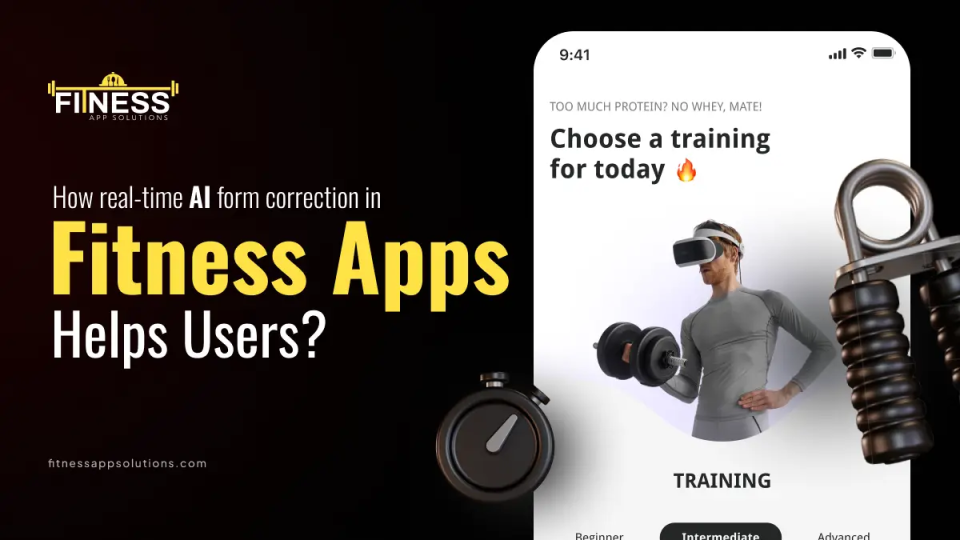
Real-Time AI Form Correction in fitness apps uses artificial intelligence (AI) and computer vision to monitor your body movements during exercise and provide instant feedback on your form. It functions like a virtual personal trainer, delivered through a smartphone, tablet, or camera-equipped device.
In real time, the AI system observes how you perform exercises and checks your posture and movement against ideal or safe standards. If your form deviates, the app immediately notifies you through voice cues, on-screen messages, visual overlays, or haptic vibrations, allowing you to correct mistakes while exercising rather than after the session.
How It Works:
- The device camera captures your movements during a workout.
- AI-based pose estimation tracks key body joints and motion patterns.
- The system compares your movements with correct exercise models.
- Instant feedback is delivered whenever improper form is detected.
Real-time AI form correction turns your device into a digital personal fitness trainer that watches how you move, evaluates your form instantly, and guides you to exercise more safely and effectively.
What are the Benefits of Real-Time AI Form Correction in Fitness Apps?
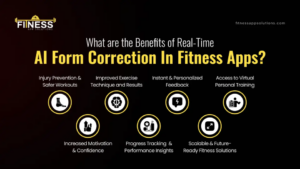
Real-time AI form correction is one of the most impactful features driving the growth of AI-powered fitness apps. By combining artificial intelligence, computer vision, and motion tracking, this technology delivers immediate, actionable feedback that helps users exercise more safely and effectively.
1. Injury Prevention and Safer Workouts
One of the primary benefits of AI in fitness apps is the ability to detect improper posture and unsafe movement patterns as they happen. Real-time alerts help users correct mistakes instantly, reducing strain on joints and muscles and significantly lowering the risk of workout-related injuries.
2. Improved Exercise Technique and Results
With accurate posture analysis, users perform exercises with correct alignment and movement. This ensures better muscle engagement, more efficient workouts, and faster progress toward fitness goals, making AI integration in fitness app solutions valuable for both beginners and experienced athletes.
3. Instant and Personalized Feedback
Unlike traditional apps that provide post-workout summaries, AI-powered fitness apps offer real-time cues through audio instructions, visual overlays, or vibrations. Over time, AI systems adapt to the user’s body mechanics, fitness level, and performance trends, delivering increasingly personalized guidance.
4. Access to Virtual Personal Training
Through advanced AI integration in fitness app platforms, users receive trainer-like coaching without the cost or scheduling constraints of a human trainer. This makes professional-level guidance more accessible, especially for home workouts and remote fitness routines.
5. Increased Motivation and Confidence
Continuous feedback builds user confidence by confirming correct movements and gently correcting errors. Many AI-powered fitness apps also gamify progress, encouraging consistency and long-term engagement.
6. Progress Tracking and Performance Insights
AI systems record movement data over time, allowing users to track improvements in posture, stability, and form. These insights help refine workout plans and support sustained improvement, one of the strongest advantages of AI in fitness apps.
7. Scalable and Future-Ready Fitness Solutions
As AI integration in fitness app technology evolves, these platforms continue to become smarter, faster, and more accurate. This scalability makes them suitable for individual users, gyms, rehabilitation programs, and enterprise fitness solutions.
How Integrating AI in Fitness Apps is Important for Business Growth?
Integrating AI in fitness apps is no longer just a technological upgrade; it has become a strategic driver of business growth. As competition in the digital fitness market increases, AI-powered fitness apps help businesses differentiate, scale efficiently, and build long-term customer value.
According to industry reports, the global mobile fitness apps market is has generated around $6.86 billion in revenue in 2024, and it is projected to generate $9.22B in 2026.
Personalized Fitness Journeys Boost Engagement
AI enables deep personalization of workout plans, meal suggestions, progress checks, and more based on individual goals, habits, and performance. Personalized experiences significantly increase user engagement and satisfaction compared with generic programs.
Improves User Retention and Lifetime Value
By continually adapting to users’ needs and keeping workouts relevant and challenging, AI-powered fitness apps increase long-term retention. Better retention translates to higher lifetime value (LTV) as users continue subscriptions or in-app purchases longer.
Facilitates Premium and Tiered Monetization
AI unlocks monetization opportunities beyond basic subscriptions, such as personalized coaching, real-ti me corrections, advanced analytics, and micro-transactions for individual sessions. These premium features can significantly increase average revenue per user (ARPU).
Real-Time Feedback Enhances Value Proposition
Features like real-time form correction and posture guidance, made possible through AI and computer vision, differentiate products in a crowded market, creating a strong value proposition that users are willing to pay for.
Scales Coaching Without Hiring More Staff
Instead of relying on human coaches or trainers, AI can deliver coach-like guidance at scale, reducing operational costs while serving millions of users simultaneously. This improves profit margins and scalability.
Enables Data-Driven Insights for Strategy
AI systems collect and analyse user behaviour and performance data. This data empowers businesses to make smarter decisions about feature development, design changes, marketing focus, and retention strategies, all informed by real user patterns.
Supports Advanced Predictive Features
By studying patterns in user behaviour and health signals, AI can predict outcomes like performance plateaus, fatigue, or risk of injury, enabling proactive recommendations that keep users safer and more engaged.
Improves User Motivation with Smart Engagement
AI can automate push notifications, adaptive challenges, gamified rewards, and milestone celebrations, increasing motivation and consistent app usage, which strengthens habit formation and retention.
Expands Market Reach and Accessibility
By offering features like virtual coaching, adaptive programs, and real-time guidance, AI integration in fitness apps makes high-quality fitness support available to people worldwide, including those without access to personal trainers. This broadens the potential customer base.
Enhances Integration with Wearables and Ecosystems
AI makes it easier to integrate and sync data from wearables, heart rate monitors, smart watches, and other IoT devices, providing a seamless user experience and creating richer insight dashboards that users value.
Drives Competitive Differentiation and Brand Value
Brands that embrace AI are seen as innovative and forward-looking. This strengthens brand perception, builds trust, and can create higher user loyalty, essential in a market that is projected to grow strongly in the coming years.
How are AI-Powered Fitness Apps Different from Traditional Ones?
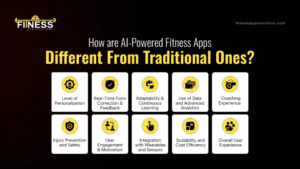
AI-powered fitness apps represent a major shift from traditional fitness applications by introducing intelligence, adaptability, and real-time decision-making into the workout experience. While traditional fitness apps act mainly as digital workout guides, AI-driven apps behave more like virtual personal trainers that continuously learn from users and respond dynamically.
1. Level of Personalization
- Traditional fitness apps usually rely on predefined workout plans categorized by fitness level (beginner, intermediate, advanced). Once selected, these plans remain mostly static.
- AI-powered fitness apps use machine learning algorithms to analyse user data such as age, body metrics, fitness goals, workout history, progress rate, and even recovery patterns. Based on this analysis, workouts are dynamically personalized and adjusted over time, ensuring that training remains relevant and effective.
2. Real-Time Form Correction and Feedback
- Traditional apps provide exercise instructions through text or pre-recorded videos, assuming the user performs movements correctly.
- AI-powered fitness apps use computer vision and pose estimation technology to monitor body movements in real time through a camera. They detect posture errors and immediately provide corrective feedback via voice, visuals, or alerts, similar to a human trainer watching and correcting form during a workout.
3. Adaptability and Continuous Learning
- Traditional fitness apps follow rule-based logic and do not evolve unless manually updated by developers.
- AI-powered apps continuously learn from user behaviour and performance trends. If a user progresses faster, struggles with certain exercises, or skips workouts, the AI adjusts intensity, exercise selection, rest periods, and scheduling automatically.
4. Use of Data and Advanced Analytics
- Traditional fitness apps track basic metrics such as steps, calories burned, or workout completion.
- AI-powered fitness apps analyse large volumes of data, including movement patterns, joint angles, heart rate, sleep data, and consistency trends. This allows them to generate deep insights, identify weaknesses, and provide predictive recommendations for better performance and safety.
5. Coaching Experience
- Traditional apps act as workout libraries where users follow instructions independently.
- AI-powered fitness apps simulate a coaching experience by offering real-time guidance, encouragement, error correction, progress evaluation, and adaptive feedback, creating a more interactive and engaging fitness journey.
6. Injury Prevention and Safety
- Traditional apps assume correct execution and do not intervene if a user performs an exercise incorrectly.
- AI-powered apps actively detect unsafe movement patterns, poor posture, or incorrect alignment and alert users instantly. This proactive correction helps reduce the risk of injuries caused by repetitive mistakes.
7. User Engagement and Motivation
- Traditional fitness apps rely on static reminders and generic notifications.
- AI-powered fitness apps use intelligent engagement strategies such as adaptive challenges, personalized reminders, smart goal setting, and gamification based on user behaviour, which significantly improves motivation and long-term adherence.
8. Integration with Wearables and Sensors
- Traditional apps may sync limited data from wearables.
- AI-powered fitness apps deeply integrate data from wearables such as smartwatches and heart-rate monitors. AI analyses this data to optimize workouts, recovery times, and overall training intensity for better results.
9. Scalability and Cost Efficiency
- Traditional fitness solutions require more human trainers to scale personalized coaching.
- AI-powered fitness apps deliver individualized guidance to millions of users simultaneously without increasing operational costs, making them highly scalable and business-efficient.
10. Overall User Experience
- Traditional fitness apps are static, instruction-based, and limited in interaction.
- AI-powered fitness apps are dynamic, interactive, responsive, and adaptive, providing a smarter and more immersive fitness experience that evolves with the user.
Hence, Summarizing It All:
| Feature / Aspect | Traditional Fitness Apps | AI-Powered Fitness Apps |
|---|---|---|
| High Level of Personalization | ❌ (mostly static plans) | ✅ (dynamic, data-driven personalization) |
| Real-Time Form Correction | ❌ | ✅ |
| Continuous Learning & Adaptability | ❌ | ✅ |
| Advanced Data Analytics & Insights | ❌ (basic tracking only) | ✅ |
| Virtual Coaching Experience | ❌ (instruction-based only) | ✅ |
| Injury Prevention & Safety Alerts | ❌ | ✅ |
| Intelligent User Engagement & Motivation | ❌ | ✅ |
| Deep Integration with Wearables & Sensors | ❌ Limited | ✅ |
| Scalability Without Increased Costs | ❌ | ✅ |
| Dynamic & Adaptive User Experience | ❌ | ✅ |
Conclusion
Real-time AI form correction is redefining the fitness app landscape by making workouts safer, smarter, and more personalized. By leveraging phone cameras, computer vision, and machine learning, AI-powered fitness apps deliver trainer-like guidance anytime and anywhere.
From injury prevention and improved performance to business scalability and user retention, the impact of AI integration in fitness apps is undeniable. As the fitness app market continues to grow, adopting AI-driven features is no longer optional; it is essential for staying competitive.
Partnering with the right fitness app development company, like Fitness App Solutions, ensures businesses can build future-ready apps that meet evolving user expectations.
Frequently Asked Questions (FAQs)
What is real-time AI form correction in fitness apps?
Real-time AI form correction uses artificial intelligence and phone cameras to analyse body movements during exercise and provide instant feedback to help users maintain proper posture and technique.
Do AI-powered fitness apps require special equipment?
No. Most AI-powered fitness apps work using a smartphone camera, though integration with wearables can enhance accuracy and insights.
How does AI improve workout safety?
AI detects incorrect posture, unsafe movement patterns, and misalignment in real time, alerting users instantly to reduce the risk of injuries.
Are AI-powered fitness apps suitable for beginners?
Yes. AI-powered fitness apps are ideal for beginners because they provide guided workouts, real-time corrections, and personalized recommendations without needing a personal trainer.
How does AI integration help fitness app businesses grow?
AI improves user engagement, retention, and monetization while reducing operational costs, making it a strong driver of long-term business growth.
Why choose Fitness App Solutions for AI-powered fitness app development?
Fitness App Solutions offers end-to-end development, AI feature integration, multi-platform support, analytics, and ongoing maintenance, making it a one-stop solution for building scalable AI-powered fitness apps.