The fitness app market in the world has risen within the last ten years. Guided exercise and calories are no longer the only workouts and devices to consider, with devices now having AI-powered coaching and wearable integrations. However, regardless of this increase, there is one area that has remained unchanged, and this is the loss of users by most fitness apps after a week.
This is not only a retention problem to fitness app developers, but also a growth limitation. The acquisition of users is ever-increasing, yet early churn erases the marketing benefits, without users having a chance to receive any actual value. One of the most vital aspects of this issue is Fitness app onboarding.
This blog will attempt to solve the following: Why are fitness apps having a hard time with early retention, why are the first week drop-offs in fitness apps psychological and usability problems, and how user onboarding best practices can significantly increase the fitness app user retention.
The First-Week Drop-Off Problem in Fitness Apps
Onboarding determines first impressions, trust, and perceived credibility in addition to usability. This is especially significant in the digital world where the level of user confidence depends on peer-reviewing and social evidence. The GoodFirms Global Online Reviews Survey (2025-26) states that 91% of the consumers believe online reviews more than the information given by marketers, thus expectations are already created without using the apps in the first place.
The Alarming Reality of Early Churn
Research on user behaviour has continuously indicated that the first week is what makes or breaks an app to be a habit or an abandonment. With applications that need continuous activity in fitness apps, initial frustration will cause quick disengagement. During the onboarding, trust, perception, and clarity are decisive.
Key Trust & Decision-Making Statistics
| Consumer Trust & Behaviour Insight | Statistic |
|---|---|
| Consumers who trust online reviews more than marketer information | 91% |
| Consumers who rely on online reviews for purchase decisions | 50% |
| Businesses stating online reviews are extremely important | 85% |
| Consumers influenced strongly by reviews in buying decisions | 62% |
| Experts stating a single positive review can improve satisfaction | 71% |
| Consumers impacted negatively by negative reviews at first impression | 80% |
Therefore, the users of Fitness apps come into the onboarding process with a predetermined opinion based on reviews, ratings, and previous experiences. Early churn is bound to occur when onboarding does not live up to these expectations.
What is the Role of Trust and Social Proof in Early Retention?
Users consider the credibility and the worth of their effort in an app before downloading and even after the initial usage.
According to the survey:
- 91% trust online reviews more than brand messaging
- 50% rely on reviews to guide purchase decisions
- 80% form a negative first impression after seeing poor reviews
Failure to reinforce expectations formed by reviews through onboarding would result in users being misled and dropping out shortly.
What are the Reasons Users Delete Fitness Apps So Quickly?
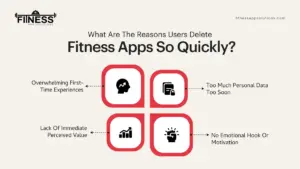
1. Overwhelming First-Time Experiences
Most fitness applications are trying to demonstrate everything they can do right away, exercise collections, eating programs, progress boards, wearable connections, and premium options, and the user does not know what the initial step is.
- Users feel instead of being motivated:
- Cognitive overload
- Decision fatigue
- Anxiety about incorrect usage
Studies show that users make a decision to store an app or get rid of it within minutes of the initial usage, which is why onboarding design is one of the key success factors.
2. Lack of Immediate Perceived Value
The users do not download fitness apps to experiment with features but to get results:
- Lose weight
- Build muscle
- Improve overall health
- Maintain consistency
Immediacy of linking the app functionality to these personal objectives is lost during the onboarding, and this leads to a reduction in motivation. This is one of the major causes of low retention of fitness app users.
3. Too Much Personal Data Too Soon
Requesting extensive personal information during onboarding, such as height, weight, diet preferences, injuries, and fitness history, often increases friction. In an absence of context, this is perceived as an intrusion by the user instead of being helpful.
The more onboarding steps are added, the greater the likelihood of the risk of abandonment, especially when it is not obvious why the data is collected.
4. No Emotional Hook or Motivation
The concept of fitness is emotional. Customers want to feel safe, motivated, and to feel that they are making progress. Applications that are transactional in nature, which are based on the dashboards and metrics without emotional support, tend to be transactional.
Apps that fail to:
- Celebrate small wins
- Encourage consistency
- Create accountability
Which ultimately caused them to have problems with user retention.
Why Onboarding Plays a Critical Role in User Retention?
Onboarding Is Not a Tutorial; It’s a Value Bridge
Onboarding is often used as a feature walk-through in many apps. As a matter of fact, Fitness app onboarding should serve as an intermediary between.
- The purpose of the download (what prompted the user to download the app).
- Practical results (what success will appear to be like)
Onboarding is an effective way to answer three important questions at once:
- What should I do first?
- Why does this matter to me?
- What will this do to assist me in achieving my objective?
Any lack of response to such questions leads to quick abandonment of users.
User Onboarding Best Practices for Fitness Apps
1. Goal-First Onboarding (Not Feature-First)
Successful onboarding begins with understanding user intent. Asking about fitness goals and availability creates relevance and personalization from the outset.
Such a change of app-centric to user-centric design has a direct positive impact on fitness app users’ retention.
2. Progressive Disclosure of Features
High-retention apps introduce functionality gradually:
- Day 1: One clear action (e.g., a short workout)
- Day 3: Basic progress tracking
- Day 5: Personalization
- Day 7: Social or gamified elements
This approach reduces overwhelm and builds confidence.
3. Early Wins Within the First Session
Users require instant reinforcement. By doing a small task, the momentum is gained, and the chances of returning are higher. Early success experiences have been established to lead to increased retention of users of the fitness app.
4. Personalization Without Pressure
Contemporary users desire customization but do not like friction. Smart onboarding takes optional inputs, smart default, and profiles that can be edited later in the journey.
5. The Power of Accountability and Habit Formation
Streaks, Daily Goals, and Gentle Reminders: The first-week retention is strongly affected by the mechanisms that are habit-forming. The features of accountability promote consistency without fear.
Gamification: Helpful, Not Distracting: When implemented strategically, gamification:
- Reinforces consistency
- Visualizes progress
- Encourages motivation
Nevertheless, too much gamification throughout the onboarding process may divert users on essential activities. Incentives must be associated with significant behaviour, but not just use of the app.
The Developer Perspective: Why Onboarding Fails So Often?
Onboarding is difficult among many fitness apps developers due to:
- Feature-heavy roadmaps
- Hard work to prove that it works.
- The initial attempts at monetization.
Nevertheless, it has always been proven that retention is a revenue generator. Those users that are not lost after the first week have a high probability of converting and being loyal.
Measuring Onboarding Success
Key metrics include:
- Day 1, Day 3, and Day 7 retention
- Onboarding completion rates
- Time to first meaningful action
- Drop-off points within the onboarding flow
Optimizing even one of these metrics can materially improve fitness app user retention.
How Better Onboarding Fixes the First-Week Problem?
When onboarding is executed effectively:
- Users feel supported rather than judged
- Progress feels achievable
- The app becomes a trusted partner
The result is higher trust, stronger habits, and longer user lifetimes. Fitness app onboarding is a competitive edge in a highly competitive market.
Conclusion
It is not the lack of interest in health and wellness that causes early user drop-off in the fitness apps, but rather ineffective early experiences. The initial week is what defines whether the users develop a habit or drop the app completely. The onboarding of a strong fitness app is a decisive factor in enhancing the retention of users of the fitness app with the reduction of friction, strengthening trust, and providing immediate value.
To the fitness apps developers, the implementation of the best practices of user onboarding, including goal-first onboarding, gradual feature introduction, and initial moments of success, could greatly decrease churn and sustain future growth. Better onboarding is not a luxury in a competitive market, but a retention strategy that is essential.
Frequently Asked Questions (FAQs)
How come fitness apps lose users within the first week?
Fitness apps have been known to lose users because of complicated onboarding processes, value unclarity, over-requesting of data, and a lack of motivation in the initial use .
What is the impact of onboarding on the retention of users of fitness apps?
Good onboarding can make users gain value faster, create confidence, and promote consistency, which directly leads to better retention of users of fitness apps.
Which are the most appropriate onboarding practices of fitness apps?
However, the main user onboarding best practices are goal-first onboarding, progressive feature introduction, initial success experience, and optional personalization.
Why should there be trust in the process of onboarding fitness apps?
Reviews and First impressions are extremely important to the user. The expectancy-based onboarding creates trust and minimizes initial churn.
What is the measure of onboarding success by the fitness app developers?
To measure success, Fitness app developers can monitor Day 1-7 retention, onboarding completion rates, and time to first meaningful action.